
Limpets, periwinkles and anemones in July 2008 (underwater picture)
(it's all geology!)
Check out the following web site:
http://www.montereybayaquarium.org/animals/default.aspx
Look up "chiton" and "limpet" and "periwinkle" - note that
these are the creatures responsible for the numerous pock
marks that we saw in the sandstones at O.B.
Explain how these creatures make these depressions in the rocks.
Limpets, periwinkles and anemones in July 2008 (underwater
picture)
Review page 113 of our lab manual "Formation of Sedimentary
Rocks" and Figure 6.4 (page 114).
Also check out this not-too-bad WikiPedia article: http://en.wikipedia.org/wiki/Limonite
What three minerals did we see that were cementing the sandtones along the cliffs in Ocean Beach, and what colors did they make the sandstones?
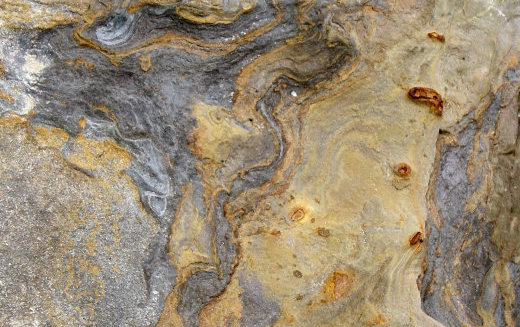
Multi-colored sandstone in July 2008
Review the information on the mineral pyrite in Laboratory Three, including Figures 3.6A and 3.21, and check out this website: http://www.gamineral.org/writings/pyrite-camp.html
What did the pyrite crystals we saw look like?
If they formed in place, in the last few tens of years, where did the iron and sulfur come from to make them?
Toward the end of our walk, we saw some white crusty
"stuff" that had been deposited on the rocks within the
previous few hours (after the last high tide).
Check out this web site:
http://www.waterencyclopedia.com/Mi-Oc/Ocean-Chemical-Processes.html
- scroll down to the diagrammatic picture showing salts
being added to and removed from the ocean. Read the
caption.
Explain how the white crust was formed.
Here's the WikiPedia article on seawalls: http://en.wikipedia.org/wiki/Seawall
We saw at least five different styles of these things. Describe three of these styles (what they look like, material involved, etc.) and give your opinion of how effectively they might control slope erosion.

Seawalls in October 2009
Here's another Wiki for you: http://en.wikipedia.org/wiki/Joint_(geology) - we were looking at what WikiPedia is calling "unloading joints."
The accompanying picture shows where we started. Note the light-colored steps at the top right of the Google Earth image. Also note how wide the two indicated joints are. Why are they so wide now if they simply start out as cracks in the rock?
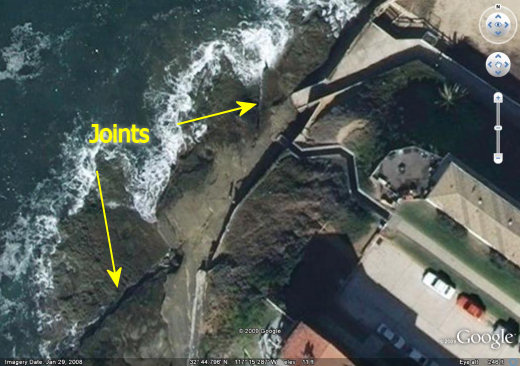
Google Earth image, January 2008
We saw numerous trace fossils along the way.
For a refresher on what we saw, check out http://www.peripatus.gen.nz/paleontology/trafos.html - note that most of the things we saw were similar in appearance to Figure 3 on the web site.
What is a trace fossil, and what do the ones we saw represent?
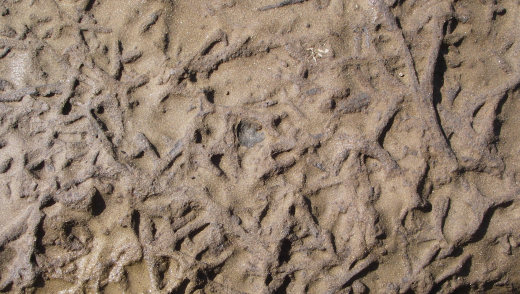
Trace fossils seen on our trip
At the very end of where we walked, we saw a many large boulders of plutonic rock piled up againt the base of the cliffs.
The WikiPedia page, http://en.wikipedia.org/wiki/Riprap describes these in more detail.
In your opinion, will these be more or less effective than a seawall in mitigating coastal erosion?
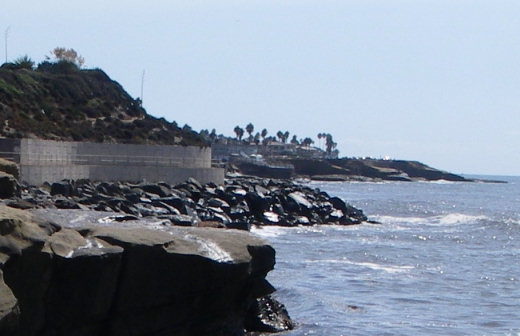
Rip-rap seen on our trip
These were the little white branching things we saw in the first few tidal puddles (pools?) we looked at.
Here's a nice article about them: http://en.wikipedia.org/wiki/Coralline_algae - check it out.
Can you think of two ways these plants can help pull CO2 from the air to mitigate global warming? Explain.
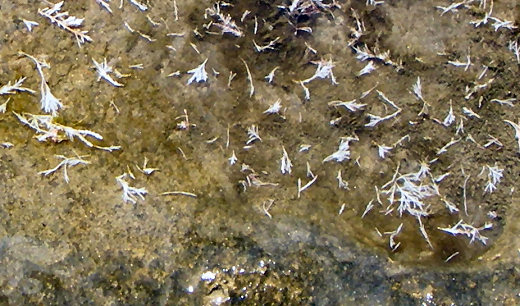
Coralline algae seen on our trip
Just offshore from our location on the field trip, we saw the kelp forest. We also saw pieces of the plants washed up on shore.
The Wiki site http://en.wikipedia.org/wiki/Macrocystis_pyrifera has a great deal of information on these magnificent plants and their communities.
San Diego has a long history of making use of kelp resources, going back at least 100 years. The main company harvesting kelp (called Kelco) is still based in San Diego. This web site http://montereybay.noaa.gov/sitechar/kelp4.html, tells a bit about the some of the uses of kelp.
What are these uses?
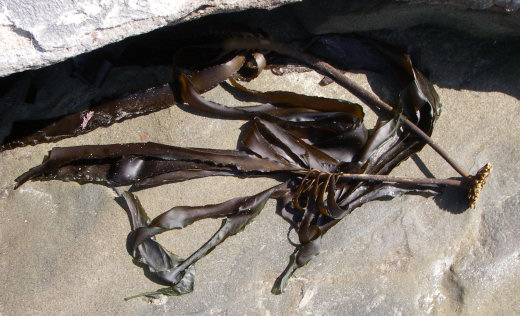
Kelp seen on our trip